What Is Britpop
How a handful of British guitar bands answered grunge, fought a famous chart battle and defined the sound of the mid-1990s.
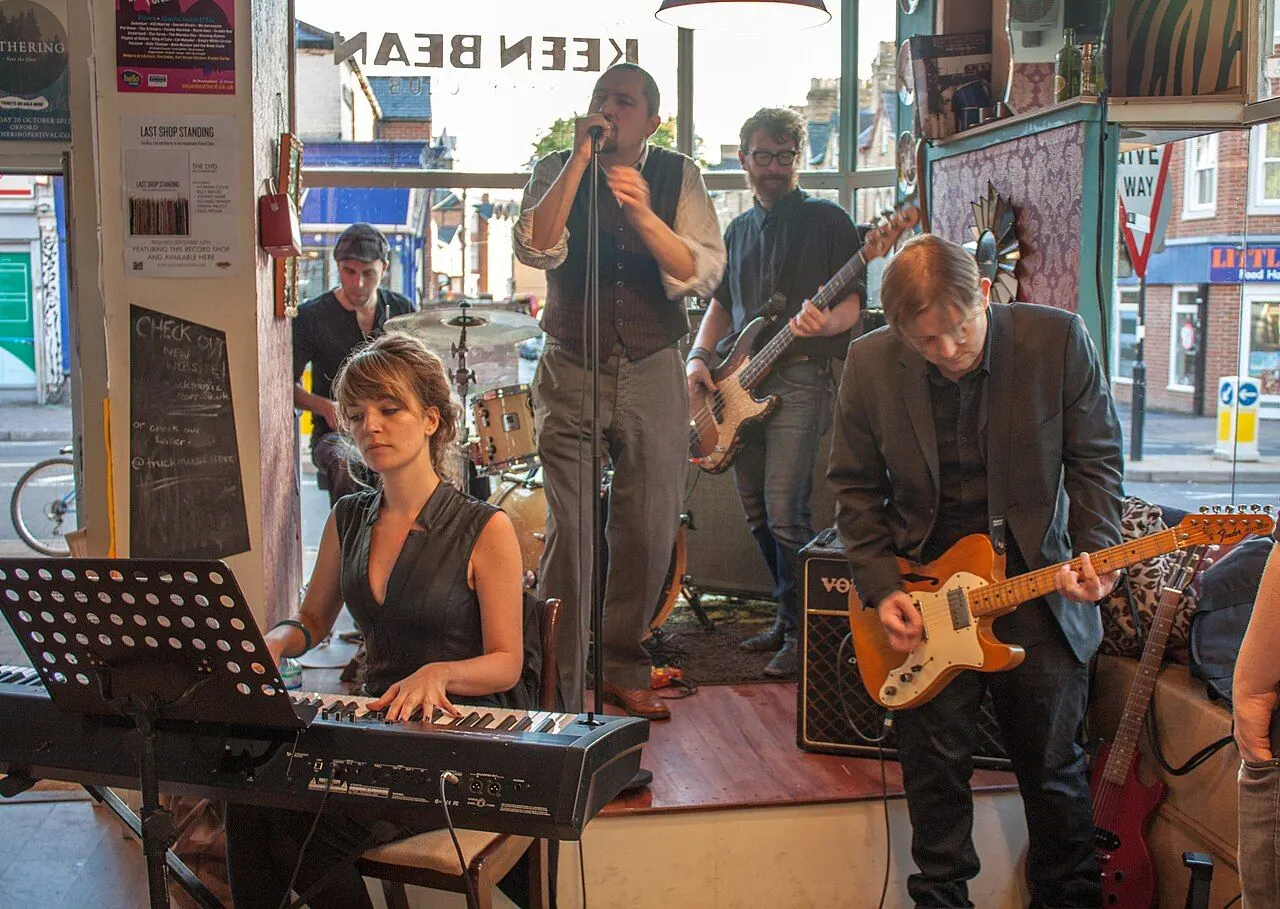
Photo: Simon Q / Wikimedia Commons, CC BY 2.0
Britpop was a British guitar-pop movement of the mid-1990s, roughly 1993 to 1997, that turned bands such as Blur, Oasis, Pulp and Suede into household names. It drew on the melodic tradition of 1960s British pop and sang openly about British life, making a national pop movement rather than a fringe trend.
What Britpop was
Britpop was a British music and cultural movement that emerged in the early 1990s. Its bright, catchy alternative rock drew heavily on 1960s guitar-based British pop, with the Beatles as the obvious ancestor, and on the glam and indie that followed, and its lyrics dwelt on British identity and everyday life. It was partly a reaction to the darker American grunge that dominated the early 1990s. Suede's debut single "The Drowners" came out in May 1992, and in April 1993 Select magazine put singer Brett Anderson on its cover in front of a Union Flag under the headline "Yanks go home!", helping to fix the idea of a new British movement.
The bands and the 1995 chart battle
Suede, Blur, Oasis and Pulp are usually called the movement's big four, with Elastica, Supergrass and many others associated with the scene, so it was never just Oasis versus Blur. Still, one chart battle defined the moment. In August 1995 Blur's "Country House" and Oasis's "Roll With It" were released on the same day, in a contest the press dubbed the "Battle of Britpop". Blur won: "Country House" went in at No.1 and "Roll With It" at No.2. The Official Charts Company counts it among the most famous chart battles in its history.
The contest came out of the groups' long-running rivalry. Blur had led the way with their 1994 album Parklife, while Oasis had arrived that same summer with Definitely Maybe. Both bands went on to top the UK Albums Chart later in 1995, Blur with The Great Escape and Oasis with (What's the Story) Morning Glory?.
Cool Britannia and what lasted after the peak
The music fed a wider mood of British pride in fashion, art and politics that the press called Cool Britannia. In March 1997 Vanity Fair put Liam Gallagher and Patsy Kensit on its cover for an issue celebrating London as the coolest city on earth, and in the summer of 1997, three months after Labour's election victory, Tony Blair hosted a Downing Street reception at which Noel Gallagher was among the guests.
The peak did not last. By 1997–98 the movement had run out of steam: Blur turned towards a rougher American-influenced sound on their 1997 album Blur, Radiohead's OK Computer pointed somewhere more experimental, and Oasis's much-hyped Be Here Now was widely criticised as overblown.
Its legacy is easier to hear than to measure. The idea that a British guitar band can write big, melodic, sing-along songs about ordinary British life runs through much of the indie that followed. For a listener starting out, the albums above, plus Pulp's Different Class and Suede's debut Suede, cover the movement's range in a handful of records.
Checked against the sources below at the time of writing. Ticketing rules, licences, royalty schemes and festival policies change; confirm with the official body, venue or organiser before you rely on them.